
The Airport Goodbye Was Just the Beginning
You fasted, you prayed, you gathered the proof of funds, and the visa finally got approved. There was a celebration. There were tears of joy.
But then came the day at the airport. One person boarded the flight to build a better future in the UK, Canada, or the US. The other person went back home to hold the family together in Nigeria, Ghana, or Kenya.
Everybody understands the economic reasons for relocating. We all know why people Japa.
But what nobody talks about is what happens to the marriage the moment that plane takes off.
Suddenly, your relationship is reduced to weekend video calls, quick WhatsApp messages, and conversations about exchange rates. You both love each other, but quietly, you are both exhausted, lonely, and starting to feel like strangers.
If this sounds like your reality, you are not alone. Let’s talk about the hidden traps of a long-distance relocation marriage—and more importantly, how you can fix them.
Trap 1: “We Will Talk When We Can”
When you are living in two different time zones with two completely different daily routines, the easiest thing to say is, “We will talk when we are both free.”
This is the fastest way to lose connection.
Why? Because life is busy. The spouse abroad is working double shifts to pay high rent. The spouse back home is managing the children, the school runs, and the generator all alone.
When you only talk “when you can,” the conversations become purely about logistics. Did the money arrive? Did you pay the school fees? What time is your next shift?
The Fix: You don’t need to talk for two hours every day. You need what we call a “Daily Anchor.” This is a simple, non-negotiable 5-minute check-in where you don’t talk about money or the kids. You just ask: How are you feeling today? What was the hardest part of your day? It keeps your hearts connected, even when you are busy.
Trap 2: The “Remittance” Trap
Money sent home is a sign of love and care. Nobody disputes that.
But in a long-distance marriage, money can slowly become a replacement for emotional intimacy. The spouse abroad feels like an ATM, working tirelessly and feeling unappreciated because the demands from home never stop.
The spouse at home begins to feel like a dependent. They hate having to constantly ask for money, waiting for alerts, and feeling like every decision requires permission.
The Fix: You have to separate the financial arrangement from your emotional relationship. Treat the monthly household money as a fixed “operating cost” that doesn’t need to be debated every week. Once the financial rules are set, you can get back to actually loving each other.
Trap 3: The Weight of Solo Parenting
If you are the spouse who stayed behind with the children, you know this truth: you are not a single parent, but you carry the exact same weight as one.
There is no one to take over when the baby cries at 2 AM. You are the sole manager of the house.
Meanwhile, the spouse abroad feels like a spectator. They want to be involved, but their advice often arrives too late, or it sounds like criticism to the tired spouse back home.
The Fix: The absent parent must remain present in ways that the child can actually feel. It’s not just about paying school fees; it’s about sending a 1-minute voice note directly to the child, or having a unified discipline rule so the kids know that Mommy and Daddy are still a team.
Love Is Not Enough (You Need a System)
Here is a hard truth that most couples don’t want to admit:
Japa does not break marriages. Unpreparedness does.
If you think that your love is “strong enough” to survive the distance without making any changes, you are taking a massive risk. A marriage under the pressure of different time zones, different currencies, and extended family interference needs more than just goodwill.
It needs a system.
You need a clear plan for your communication. You need a transparent protocol for your finances. You need an exit plan so you know exactly when the distance will end.
How to Protect Your Marriage Today
You migrated to build something better for your family. Don’t let the distance destroy the very family you are working so hard for.
Because nobody prepared us for this, we decided to create the blueprint ourselves.
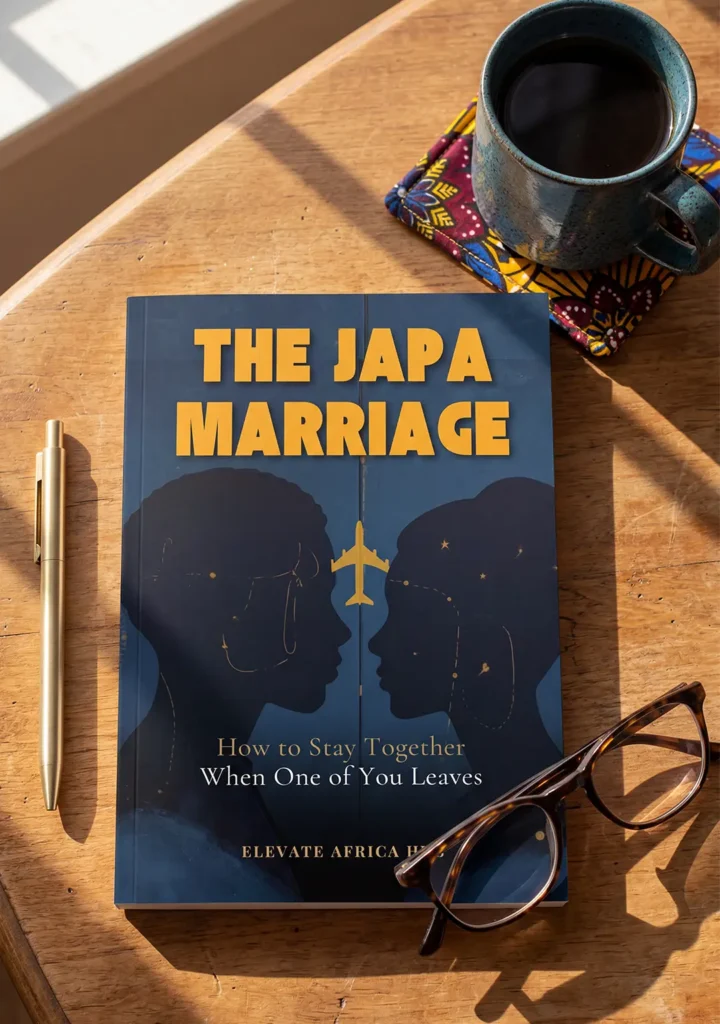
It’s called The Japa Marriage: How to Stay Together When One of You Leaves.
This is not a generic relationship book written by Western therapists who don’t understand the African reality. This book is written specifically for you. It tackles the naira/cedi pressure, the visa struggles, the in-law interference, and the deep loneliness of living apart.
Inside this digital guide, you will find 12 powerful chapters and 14 practical tools, including:
- The Communication Stack: How to stop arguing over WhatsApp.
- The Household Financial Protocol: A simple template to manage money across borders without resentment.
- The Transparency Agreement: How to handle loneliness and protect your marriage from infidelity.
- The Family Vision Charter: A step-by-step guide to planning your ultimate reunion.
Don’t Wait Until You Feel Like Strangers
You can start fixing the disconnect right now. The best part? Because it is a digital guide, you and your spouse can download it instantly and read it together, no matter what time zone you are in.
 [Click Here to Download ‘The Japa Marriage’ Instantly]
Distance is just a circumstance. Disconnection is a choice. Choose to pick up the pen and write a beautiful survival story for your marriage today.
Have you or your spouse recently relocated? What has been the hardest part of the distance for you? Share your thoughts in the comments below. let’s support each other in this journey!